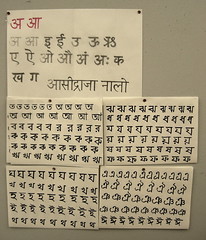
The pressure is on! Even though it isn’t the case that each typeface design student at Reading has tackled a non-Latin component as part of their work, it feels like it. Last week, we rolled up our sleeves and drew out sets of non-Latin scripts for the first time, or at least the first time with other people looking. From Tuesday through Thursday, we participated in a workshop regarding North-Indian scripts—Devanagari, Bengali, and Gujarati. I guess that the point of the workshop was to write out a lot of different kinds of characters in order to get an introduction to—and feel for—these writing systems.
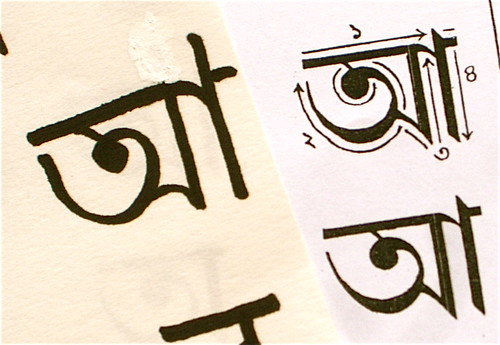
I’d already decided to try and integrate Devanagari into my practical work, but I spent a few hours writing out 45 Bengali characters on Wednesday night and Thursday morning; so delightful! Bengali is curvy, and really a lot of fun. It also looks very difficult. I’ve love to design a Bengali typeface, but the idea of trying to wrangle those shapes with bezier curves—or really with any instrument or technology—makes me want to hide under the table. I didn’t attempt to write much with a proper nibbed or reed pen; Bengali incorporates e number of thick up-strokes. I have no idea how one makes one’s pen do that. Or one’s hand, wrist, etc…
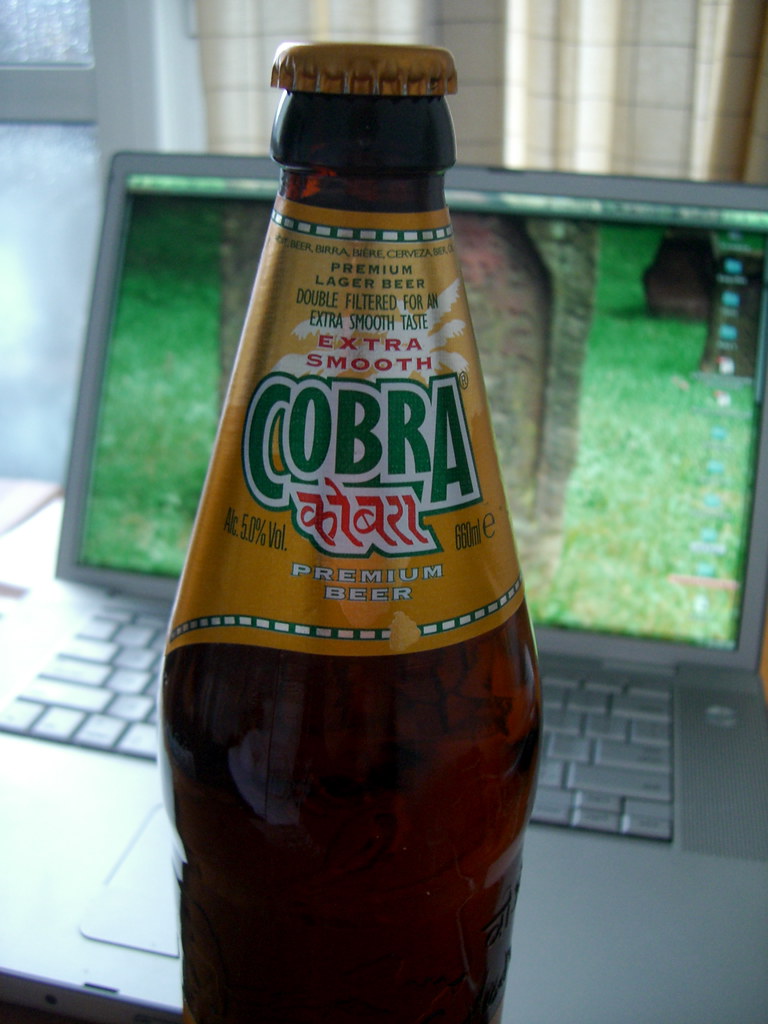
After the workshop had ended, it was time to celebrate! When I went to the store to pick up a few bottles of beer, I found this on the shelf. It was the only beer in stock from India, and moreover, it had this lovely script on the label. I had to buy it! Tastes like any average beer, though.
Mathieu already wrote up some of his thoughts about the workshop over the weekend. As always, they are worth reading.
Comments
14 responses to “First Non-Latin Workshop results”
Dan, if you can get hold of a broad nib cut for a left-handed writer, you will find this, in your right hand, a helpful way to write Devanagari and Bengali, because you won’t need to rotate your hand so far.
Thanks, John, I think I’ll do that!
Hi Dan,
Yes, it says “kobaraa” in Devanagari on the label:
“\u0915\u094B\u092C\u0930\u093E”
Another way to transliterate it would be “kobraa”:
“\u0915\u094B\u092C\u094D\u0930\u093E”
Cheers,
Christopher
Hmm… WordPress seems to have eaten your Devanagari. Sorry :( Thank you though!
I’m going to see if I can get Devanagari posting working here. It sure beats working on my typeface…
OK, Chris… I’ve installed a plug-in into WordPress (Character Map) that allows me to convert between glyphs and values when I write. This doesn’t work for you when you type comments here, however. If anyone knows a work-around, I’d be very happy to hear about it.
But you can enter in any Unicode-supported characters by typing in those codes that begin with &#…
With kobaraa (\u0915\u094B\u092C\u0930\u093E), for instance, you would enter the text in as the following string—without any spaces—
& #2325;& #2379;& #2348;& #2352;& #2366;You have to do this instead of typing in the Devanagari in order for it to display correctly. See?कोबरा
kobraa (\u0915\u094B\u092C\u094D\u0930\u093E) then needs to be entered in as
& #2325;& #2379;& #2348;& #2381;& #2352;& #2366;to get this –कोब्रा
Here are those two works written with Devanagari one more time, just for good measure: कोबरा कोब्रा
The very top of the label also has the following text:
“बीअर, BEER, BIRRA, BIÈRE, CERVEZA, BIER, ÖL”
Too small for me to photograph with my camera, but I guess that the Hindi word for beer is बीअर ?
Love this kind of post. Have you ever tried Japanese Katakana or Hiragana?
>Have you ever tried Japanese Katakana or Hiragana?
No! Unfortunately not. When I was in college, I took three semesters if Mandarin, in which time I wrote out a far number of Traditional Chinese characters. But that wasn’t designing.
Hi Dan,
OK, I’ll try the &#dddd notation…
“बीअर” (“\u092C\u0940\u0905\u0930”) is “biiar”, so, yes, “beer”. That said, I think “beer” is more commonly transliterated as “बियर” (“\u092C\u093F\u092F\u0930”) “biyar”.
Cheers,
Christopher
Fantastic!
Hallo Dan!
i am graphic design student studying in japan, and i come from india! hence your post had an even greater meaning to me!! it is nice to see how you enjoyed the devnagri scripts!
i love typography myself and i love the indian scripts especially the bengali and also tibeten.
i want to create some typography using the indian scripts and the japanese scripts, but not got any where close yet.
i was wondering did you try the katakana and hiragana? or the kanjis? i noticed that this page is form long time back… but still i thought of asking again!
think you must try writing these scripts (tibeten and bengali) with a brush like japanese and chinese caligraphy… it works!!
p.s i am Gujrathi!! :D
greetings
hirisha
Dear Hirisha,
Thank you for your post. During the year that I studied in Reading, we participated in a small series of workshop like this: one for Northern Indian scripts, one for Southern Indian scripts, one for Arabic, and one for Greek. Unfortunately, we did not spend time with East Asian scripts. I have done a small bit of typesetting in Chinese, but I don’t have any experience writing or typesetting Japanese. Still, I totally encourage you to try writing Japanese and North Indian texts together with the same sorts of writing instruments, to see what results you will get (markers, pencils, brushes, angled reed pens …).
Cheers,
Dan