
I’ve been quiet for a few weeks. After three-quarters of a month in Germany, I returned to England on Tuesday, January 8th. The submission date for our first essay was Monday, January 14th; by the time I arrived back in Reading, I was already in the midst of the writing. So what’s been going on since I installed Vista on my MacBook Pro?
International travel fun

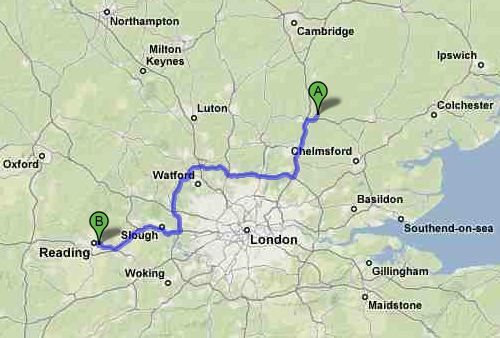
On the 8th itself, for instance, my plane arrived at Stansted airport at 10:30 am; the flight from Berlin-Schönefeld was shorter than the train trip from Stansted to London; the train in front of my train broke down, and we sat in place for quite a while. By 1 pm-ish, I was at Reading station. I took a taxi to my apartment, and was home by 13:30.
A three-week pile of mail was blocking my door, most of it addressed to previous occupants. Nevertheless, a number of Christmas gifts were in there as well, including things from Linotype and my parents. Plus, there were magazines: Slanted, PAGE, and STEP Inside Design. Actually, this was sort of my best mail day ever! But I just pushed it all into a corner, dropped my bags, left, and walked up the hill to the University campus. I got to the typography department by 14:20, about 20 minutes late for Gerry’s class.
The essay process
Everything that happened during the subsequent six days is all just a blurry memory now. I seem to remember something about not shaving, writing, answering English questions, proofreading an other essay, trying to figure out the department’s less good and more good printers at 1 am and 8 am respectively, and spending the night of the 13th inside the department with all those typography ghosts. If I hadn’t started working on my essay over the break, I never would have finished on time.
What was it all about anyway?
For my essay topic, I selected Devanagari text typefaces. At first, I’d considered writing a comparative analysis of available fonts on the market. I did veer into this general direction, but I was so surprised to discover the difficulties of setting Devanagari typefaces that my essay spawned a long introductory half which discussed the script’s support on the Mac and on Windows. We were directed to submit 4000 words. My word count, not including footnotes, images, captions, appendices, and the bibliography was about 4300.

The weather
What was the weather like during and after the essay-writing? Well, a bit like this (link!): Sometimes it was windy. There was also occasional precipitation. When that would pass, we’d have wind and rain together. Otherwise, the weather is not wintery at all, more like cold November.
Typeface design
The new year marked the start of a new term. The last term began slowly. Lots of sketching and reading… I even missed the first week of it back in October. The second term is already very different. First we had the essay. Then we submitted the essay. The next morning, Gerard Unger had already arrived from the Netherlands for another several-day session. That means that we finished working on our essay, got some sleep, and parachuted right back into our typeface design projects.
Dave Crossland and his XO laptop
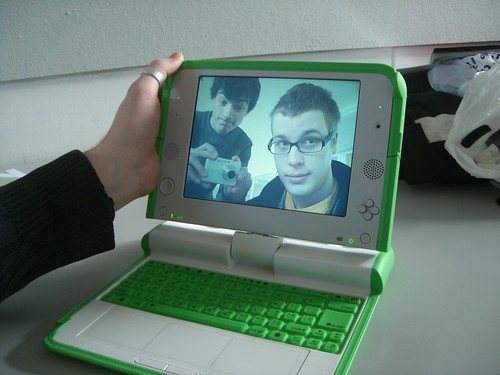
On Wednesday, Dave brought in his copy of the one-laptop-per-child machine. I’d been hearing about this for years, and was really anticipating finally seeing it! But I must admit, I was disappointed… kids want grown-up computers, too! What’s the deal? It looks like a cross between a Nintendo DS and a first-generation, clam shell iBook :( Great concept, but I hope that the screen and the keyboard will get a little bigger when the inevitable next version is produced.
Never mind the stories, what does the typeface design look like now?

Comments
11 responses to “What January has been likes so far”
The XO is small because it is aimed at 6 year olds,who have small hands :-) I imagine that the later versions will be bigger because (a) they will have bigger hands by then and (b) it will be cheaper to manufacture the cutting edge screen in larger sizes
I love computers, and have been using them since I was at least four… but six in school is a bit young, really, at least in my opinion. Also, if you aim a product at six-year-olds, I doubt that 10-year-olds will find it cool, which is this market is sad.
Welcome back, Dan, and a belated Happy New Year to you.
I like this kind of post. Can’t believe you so nonchalantly wrote, “Gerard Unger had already arrived from the Netherlands for another several-day session.” I think I’d be speechless if I met him, or just say something completely stupid, like “can you sign my copy of While You’re Reading?” In fact I’ve just finished writing a review of it. Do you know if he designed the entire book? Well, that’s enough about Unger–I’ve got work to do, but first I just need to buy a domain…I wonder if iloveUnger.com is taken?
ps: would love to read that essay some time.
This typeface looks really promising. I’m falling for the “y” and “w”.
It looks like you have a few hours of kerning to do. Have a great time!
Loyal (scary, right?) lurker, Ómar.
Johno
>Can’t believe you so nonchalantly wrote, “Gerard Unger had already arrived from the Netherlands for another several-day session.”
Well, I should qualify this.:Gerard is in Reading every few weeks for multi-day sessions. It is par for the course, so to speak. This week was his fourth visit.
>I think I’d be speechless if I met him, or just say something completely stupid, like “can you sign my copy of While You’re Reading?” In fact I’ve just finished writing a review of it. Do you know if he designed the entire book?
Yes, I think that he did.
>I wonder if iloveUnger.com is taken?
:)
>ps: would love to read that essay some time.
I’ll e-mail it to you.
Ómar
Thank you for coming out of the lurker shadow and posting! I’ll try to keep posting comment-worthy writing, and images, too…
Hmm, I’m not sure about the 10 year olds not finding it cool; I have no idea how cool works in Nigeria or Peru :-)
I don’t know why OLPC decided to target 6 year olds either; I guess its the school-starting age.
Oh come on! Different age groups have different interests and ideas; one cannot market something to both 6 and 10-year-olds. Can you market the same product to 10 and and 14-year-olds? I doubt it!
The OLPC is a great idea! That’s why I can’t understand its implementation :(
“Can you market the same product to 10 and 14-year-olds?”
Not in the UK in 2008.
Or at least, not in a way that sells in this marketplace, because fine grain market segmentation of children’s products was complete a long time ago. So your competitors who are pursuing a segmented strategy will likely beat you because at this point in the market timeline they are responding to market demands.
The market wasn’t always segmented this way, thinking of the toys my parents had as kids. Since the 70s, products for kids have typically been designed to have limited interest lifespans, as that encourages consumerist buying habits. So kids are conditioned to disdain products targetted at their past selves and clamor for ones targetted at their future selves. We don’t have coming-of-age rituals and kids want to be adults quicker than they used to; teen smoking and pregnancy levels vary from culture to culture, and are good indicators of this dynamic.
Another interesting aspect of kids products in the UK’s 2000s market is that they are also marketed at adults – Qee/Kubricks dolls, powerball gyroscopes, etc
The market for kids products in developing countries is pretty different though – precisely how it is different I don’t know, although I expect it varies from place to place. This is what I mean when I say I don’t know “how cool works in developing countries.”
Maybe globalisation is further along than I presume, but I find projecting developed countries’ market characteristics onto developing countries strange :-)
However, all of that, while interesting, is totally irrelevant to OLPC.
Firstly, their laptops are marketed at Ministries of Education, not kids. What school a kid goes to is not up to the kid, and mostly is not up to the parents either. The UK MoE gives laptops to dyslexic kids, and they are pretty shitty ones, but the kids don’t complain they aren’t cool enough. Was the school you went to when you were 10 less cool than the school you went to when you were 14?
Secondly, computers are exceptional products. There is an infinite number of purposes that computation can be put to, so they are routinely marketed at all age ranges and all markets for all kinds of purposes. Its software, not hardware, that really differentiates computers from one another.
My physical computer was basically a different product yesterday because I installed a range of video editing software on it this morning.
The software in a computer from OLPC is written to span all the interests and ideas of all ages. For example:
A 6 year old is likely to find the visual games, camera, and drawing programs most fun.
A 10 year is likely to find the (logo equivalent) simple Turtle Art programming visualization environment and the four sophisticated music making programs the most fun.
A 14 year is likely to find the eToys interaction programming environment and the web the most fun.
The low age seems to be chosen because “digital activities will help the acquisition of the writing and reading skills.” I personally find curiosity the best motivator for learning, and I expect that owning a laptop which requires literacy to be properly used makes learning to read and write addictively tantalizing.
The OLPC idea is made up of five core ideas: child ownership of laptops; low ages; community saturation; digital network connectivity; and software freedom. It appears to be succeeding at implementing all of these to me, so I hope you’ll consider writing a longer blog post about your conception of what the idea of OLPC is, and how its implementation isn’t fulfilling that idea :-)
(Thanks for the good discussion :-)
>Maybe globalisation is further along than I presume, but I find projecting developed countries’ market characteristics onto developing countries strange
I suspect that the OLPC will increase globalisation, actually. But I like globalisation, and I am of course a product of it.
In fact, I wish the OLPC were a little more global than it is… the installed fonts for instance. I don’t like that some fonts are installed on some builds, but not others. That makes a lot of assumptions… especially on the American build you have. I doubt that there is major linguistic group out there that doesn’t have children speaking its languages inside the US, too. The US OLPC doesn’t have some big Indic fonts on it… why not? What if said American child is living in a bi-lingual household? What if he e-mails relatives back home? Sure, the software is free, so you could install the fonts yourself, but that seems to fly in the face of “plug and play” to me. If the two big OS manufacturers can manage to get all the scripts they support in my American, UK, or German version of the OS, why not the OLPC, too?
>Firstly, their laptops are marketed at Ministries of Education, not kids.
All the more reason to make it look less like a toy ;-)
Seriously though, I think the design is fine, just too small. I’d rather see it standardized to 10-year-old’s hands. 6-year-olds will grow up quickly, and this computer will have to last them a few years. The same thing with 10-year-olds who get it… no one is going to keep this from ages 6–14… after 8 years, it’ll be obsolete, broken, or both.
Also, if it is a 10-year-old’s tool, then 6-year-olds will want it, and they’ll have something (and someone) older to look up to. That is good. Also, the chances of a 14-year-old giving it the time of day would probably be better if it were closer along the continuum to his age group.
>Was the school you went to when you were 10 less cool than the school you went to when you were 14?
Yes, actually. And significantly so, for many reasons. But the biggest reason, in the US at least, is that, say, from my age 5–10, I was in elementary school. 10/11–13 was middle school, and 13/14–17 was high school. So when I was 14, I was in a school with no 6 or 10-year olds. But it did have 16-year-olds, 17-year-olds, and 18-year-olds. And they were cooler, because they had cars and could drive (16 in the USA). I think that children project themselves forward in time, not backward.
Note also that, at my cool high school, where I was at 14 but not at 12, they have now forbidden laptops. And for good reason. First off, the school doesn’t want to spend money to support them. Second, the school has desktops that the students can use if they want, in school. Third, the school could be liable if the laptops were stolen, or if the students did illegal things with them on school property. Which leads to my fourth point: students don’t always do what they are supposed to in class when they have their laptops open.
This is even true of graduate students ;-) I think that Gerry should ban laptops from class at Reading, too. How often do we sit in class and check e-mail instead of paying attention? Well, a lot of times! (I’m sorry Gerry, I’m really trying… :( )
There is one good counterpoint for the OLPC against my old school: obviously, the students at my old high school don’t need to bring their laptops into school. They all have computers at home, so everyone is probably computer and technology literate. The target groups for the OLPC probably don’t have any computers at home at all. So, big difference, and big point for the OLPC.
>The software in a computer from OLPC is written to span all the interests and ideas of all ages
Yes, I haven’t really got a problem with the software. My beef is with the hardware. Software is much easier to change.
Globalisation is actually one of the cogent criticisms of OLPC: they get the laptops made in the far east, instead of in the countries where they are used (thus creating jobs there) – which is something the Intel-backed alternative has done.
Regarding fonts, I guess that its constraints of the computer; there is only 1Gb of disk space and 256Mb RAM; although fonts are small on disk, having them loaded in RAM would be cumbersome.
I think the whole community will give the laptops the time of day because there are no other computers in these communities. I’m not sure any kids other than 6 year olds get it, btw.
Interesting about your school; I’m a poor judge of cool, so maybe yours is the general case and I was just oblivious to it all :-)
I think the small size is good for portability, and I find the keyboard okay to use after a couple of hours of acclimatising to it.